Electrolyte analysis is a standard diagnostic practice in companion animals – for sick or injured animals, and for healthy animals during annual health check-ups or pre-anesthetic evaluations.
In veterinary practice, electrolyte point-of-care testing is mainly carried out on blood gas analyzers (BGAs) validated for veterinary use. These systems have a broad test menu. Depending on the analyzer, however, routine use can be constrained: some of these systems require maintenance, calibration and flushing or priming cycles that may reduce operational readiness. Depending on the platform, accepted specimen types may be limited to whole blood, and the required sample volume can be difficult to obtain from small or debilitated patients.
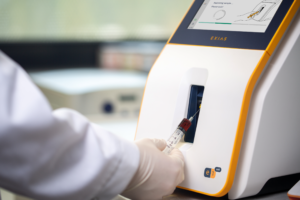
The EXIAS e|1 is a compact analyzer dedicated to electrolytes. Like BGAs, it uses ion-selective electrode (ISE) technology, and it has been available for human samples for more than six years. The study set out to verify whether this analyzer, developed for human samples, provides reliable results in dogs and cats.
What the white paper covers
Before an analyzer is introduced into clinical practice, its precision and accuracy should be characterized, and appropriate reference intervals must be available for each species. The white paper documents four steps:
- Precision – within-run and between-run imprecision on three quality-control levels and on canine blood and plasma
- Total observed error – compared with published total allowable error specifications for each analyte
- Method comparison – against the StatProfile Primevet® (Nova Biomedical®), a blood gas analyzer validated for veterinary use, in 63 dogs and 28 cats presented for routine care
- Reference intervals – verification of the comparator’s reference intervals on the e|1 Analyzer in 20 apparently healthy dogs and 20 apparently healthy cats
All tests were performed on lithium-heparinized whole blood or heparinized plasma. The e|1 requires 20 µL per test and delivers results in 25 seconds.
Key results
The white paper reports the following:
- Precision met the Westgard criterion (CV < 5%) and was generally consistent with published literature data.
- For sodium, potassium, chloride and ionized calcium, the total observed error remained below the analyte-specific total allowable error. Hematocrit met the selected expert-derived specification.
- For pH, the total observed error slightly exceeded the specification of ±0.04 pH units, although the mean systematic bias was very small.
- Method comparison showed generally good agreement with the comparator. Hematocrit results were systematically higher on the e|1 Analyzer – a difference that cannot be attributed to either instrument alone.
- All transferred reference intervals met the study-specific acceptance criterion of at least 18 of 20 compliant results, in both dogs and cats.
The author points out that this comparator-based approach supports the transfer of reference intervals to the e|1 Analyzer, but does not establish e|1-specific reference intervals.
The white paper gives the values behind each of these points, with tables per parameter and Bland-Altman plots for dogs and cats.
Practical findings for the clinic
Beyond the performance data, the white paper discusses which sample type suits which parameter. For sodium, potassium and chloride, both heparinized whole blood and heparinized plasma were suitable. For ionized calcium and pH, whole blood was the preferred matrix. Hematocrit can only be measured in whole blood.
The discussion also explains why ionized calcium, pH and hematocrit should be measured at the patient’s side, and which pre-analytical factors – such as exposure to ambient air or the heparin content of the tube – can influence the results.
During the study, the analyzer required no routine operator maintenance other than cartridge replacement according to the manufacturer’s operating procedure.