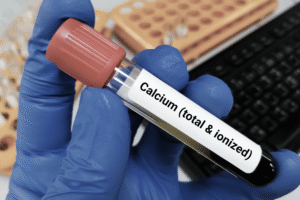
ionized calcium clinical standard

Commentaire scientifique : Mesure du calcium
15 juin 2026
The Evidence Has Spoken*:
It's Time to Measure Calcium Right
Scientific Commentary · Bone Metabolism & Laboratory Medicine

A joint position statement from the IOF, IFCC, and EFLM calls on laboratories to stop reporting albumin-corrected calcium. The evidence is unambiguous — and it points directly to direct ionized calcium measurement as the clinical standard.

* Based on Cavalier et al., Clin Chem Lab Med 2026

To the position statement

For more than fifty years, clinical laboratories have applied a formula-based shortcut: when albumin is low, adjust total calcium upward to estimate what the value would be at a normal albumin level. The idea originated in a 1973 publication by Payne and colleagues, derived from just 200 specimens and never validated against ionized calcium. Despite this, it became embedded in laboratory information systems and clinical practice with remarkable durability.

A formal joint position statement from the IOF Working Group, the IFCC Committee on Bone Metabolism, and the EFLM Committee on CKD now delivers a definitive verdict: laboratories should no longer report albumin-adjusted calcium as a routine result.

"The rationale for abandoning the practice of routine
albumin-correction is now difficult to ignore."

 Cavalier et al., Clin Chem Lab Med 2026

WHAT THE DATA SHOW

Drawing on multiple large independent datasets, the position statement demonstrates that albumin correction not only fails to improve calcium classification — it actively increases misclassification. The largest of these is a population-based cross-sectional study covering the entire province of Alberta, Canada, which included 22,658 patients with simultaneous total and ionized calcium measurements between 2013 and 2019.[1] When classifying patients as hypocalcaemic, normocalcaemic, or hypercalcaemic, unadjusted total calcium outperformed both Payne correction formulas in agreement with directly measured ionized calcium. Misclassification with the adjustment formulas was worst in patients with hypoalbuminaemia — precisely the group where correction is most often applied.

74.5%

Classification agreement with ionized calcium — unadjusted total calcium [1]

58.7%

Classification agreement — simplified Payne formula [1]

63.0%

Classification agreement — original Payne correction formula [1]

3.6 - 4.7%

Additional analytical variation introduced by albumin adjustment [2]

The formula performs worst precisely where accurate calcium assessment matters most: patients with acid–base disturbances, hypoalbuminaemia, renal dysfunction, or systemic inflammation. The physiology is clear — because pH directly alters calcium–protein binding equilibrium, no albumin-only formula can restore the relationship between total and ionized calcium when that equilibrium has shifted. In CKD and haemodialysis populations, KDIGO has explicitly confirmed that albumin-adjusted calcium does not accurately estimate ionized calcium and that clinically relevant abnormalities are frequently missed.[3] Similar findings apply in chronic hypoparathyroidism,[4] where a study of 1,215 paired measurements showed that simple total calcium cut-offs outperform corrected values, and in multiple myeloma, where paraprotein binding further invalidates any albumin-only approach and corrected calcium has been shown to miss ionized-calcium-defined hypercalcaemia.[5]
There is also a metrological dimension. Albumin-adjusted calcium is a derived estimate, not a measured quantity. Its performance varies with the local albumin method — Payne's equation was developed using bromocresol green, which overestimates albumin relative to bromocresol purple or immunometric assays — and requires population-specific revalidation over time. In an era of metrological traceability and harmonisation, this is, as the authors of the position statement state directly, "a backward step."

OFFICIAL POSITION

"Laboratories should no longer report albumin-adjusted ('corrected') calcium. Total calcium should be the default result, and ionized calcium should be ordered up front when clinical decisions depend on calcium status or when interpretation of total calcium is likely to be unreliable. In severe hypoalbuminemia and in patients on dialysis, ionized calcium should be considered the first line test."

Cavalier et al., Clin Chem Lab Med 2026

IMPLICATIONS FOR PoC CALCIUM MEASUREMENT

By rejecting albumin-derived correction and designating ionized calcium as the first-line test in complex patients, the statement implicitly elevates instruments that measure true ionized calcium directly – using ion-selective electrodes – over conventional chemistry analysers dependent on formula-based surrogates. The full position statement is available here. 

Meilleur analyseur d’électrolytes avec ISE direct

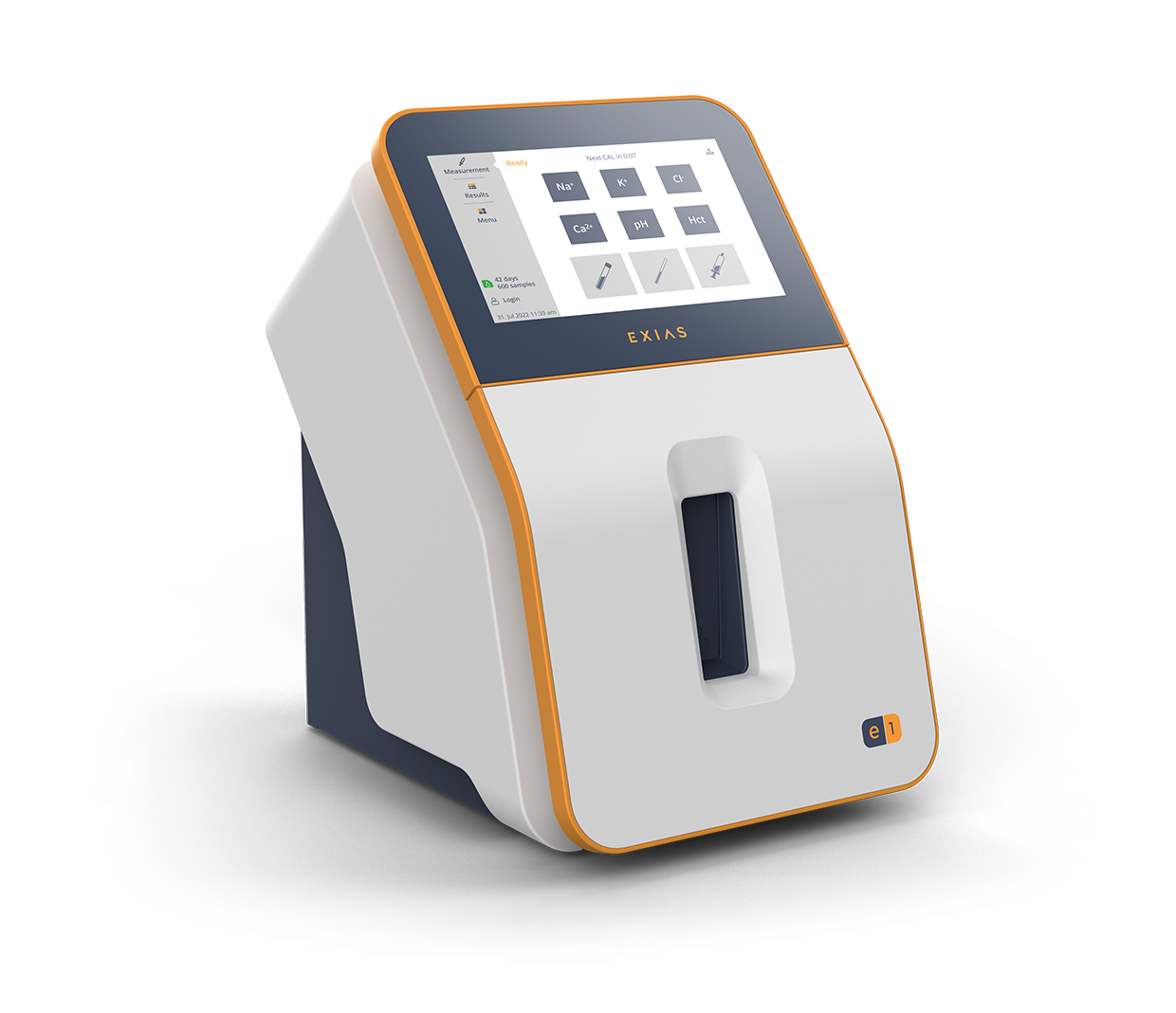
EXIAS e|1 ANALYZER

DIRECT IONIZED CALCIUM MEASUREMENT

The EXIAS e|1 measures ionized calcium directly with an ion-selective electrode, reporting the biologically active fraction at the patient's actual pH. There is no albumin-correction step, no derived estimate, and no added metrological uncertainty. The e|1 reports the measurand that the IOF, IFCC, and EFLM now formally designate as the clinical reference standard.

The transition from corrected calcium to direct ionized calcium measurement is not a disruption of clinical practice. It is the correction of a 50-year-old measurement error – one with direct consequences for patients with CKD-MBD, hypoparathyroidism, multiple myeloma, and critical illness, where calcium status determines treatment.

Primary reference
Cavalier E, Zima T, Plebani M, Langlois M, Harvey NC, McCloskey EV, Rizzoli R, Makris K, Vasikaran S, on behalf of the Joint IOF Working Group and IFCC Committee on Bone Metabolism and EFLM Committee on CKD. Albumin-adjusted ("corrected") calcium should no longer be reported: a position statement from the Joint IOF Working Group and IFCC Committee on Bone Metabolism and EFLM Committee on CKD. Clin Chem Lab Med. 2026. https://doi.org/10.1515/cclm-2026-0545

Footnotes

  1. Desgagnés N, King JA, Kline GA, Seiden-Long I, Leung AA. Use of albumin-adjusted calcium measurements in clinical practice. JAMA Netw Open. 2025;8(1):e2455251. doi:10.1001/jamanetworkopen.2024.55251
  2. Choy KW, Hickey S, Loh TP. A contemporary review of the limitations of adjusted calcium in clinical practice. Pathology. 2025. doi:10.1016/j.pathol.2025.08.010
  3. Ketteler M, Evenepoel P, Holden RM, et al. Chronic kidney disease–mineral and bone disorder: conclusions from a KDIGO Controversies Conference. Kidney Int. 2025;107:405–23.
  4. Bertocchio JP, Hecini A, Ghander C. Albumin-adjusted calcemia: time to move on for chronic hypoparathyroidism patients? Eur J Endocrinol. 2025. doi:10.1093/ejendo/lvaf258
  5. Buege MJ, Do B, Lee HC, et al. Corrected calcium versus ionized calcium measurements for identifying hypercalcemia in patients with multiple myeloma. Cancer Treat Res Commun. 2019;21:100159.
Consentement à l'utilisation de Cookies avec Real Cookie Banner